


Between hiking and climbing, via ferrata offers a unique way to discover the mountains. By moving vertically along the rock face, you can enjoy the scenery from a whole new perspective. . Via ferrata is an accessible sport that, once you've got the basics down, allows you to progress fully independently. It is a discipline that requires less equipment and technical knowledge than rock climbing. It is therefore an excellent way to discover the vertical world and let your feet leave the hiking trail below. If you're interested in getting started with via ferrata, let's walk through the steps to ensure a safe introduction.
What is the difference between via ferrata and rock climbing?
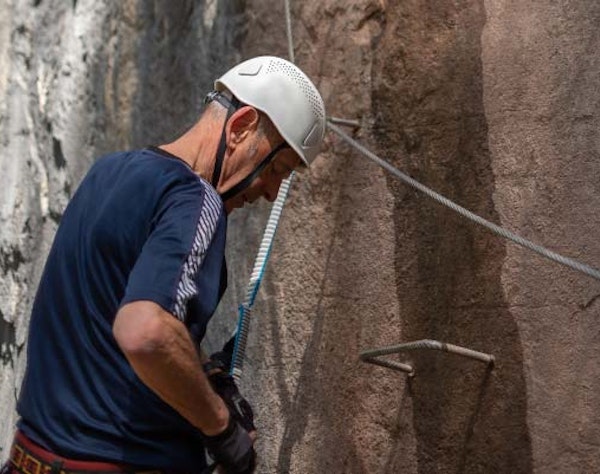
Via ferrata is an equipped route on a rock face. This means you'll be progressing using cables, rungs, ladders, suspension bridges and footbridges… On top of that, a safety line (also called a lifeline) allows you to self-belay at all times. This keeps you safe with a simple movement: clipping your lanyard carabiners onto the cable.
On the other hand, in rock climbing, the rock face is barely equipped. Climbers progress using natural features of the rock. To move safely, they use a rope threaded through quickdraws that they install themselves in the anchoring system already in place.
That is the main difference between via ferrata and rock climbing. There is, however, one thing in common: the use of a grading system. Indeed, not all via ferrata routes have the same difficulty level. The difficulty of a route is indicated by a grade that goes from F (easy) to ED (extremely difficult). Here's what each grade means so you can gauge your level:
F – Easy (suitable for everyone, including children);
PD – Slightly Difficult (perfect for beginners in via ferrata);
AD – Fairly Difficult (for beginners who aren't afraid of heights);
D – Difficult (for people in good physical condition);
TD – Very Difficult (for those who are at ease on via ferrata);
ED – Extremely Difficult (reserved for expert climbers).
Avoid taking on a via ferrata if you're a complete beginner. To navigate them safely, you need to master certain rope techniques. These techniques are easy to learn but can't be self-taught. Seek guidance from a professional or join a sports club to learn the correct techniques.


What equipment do you need to start via ferrata?
Via ferrata democratizes access to the mountains and to the vertical world. However, the sense of security provided by solid, well-maintained equipment should not cause you to overlook the risks associated with mountain activities. You should not neglect this equipment. Before starting via ferrata, you need to have:
A climbing helmet, to protect you from falling rocks, or if you fall – it must be certified and must not have been involved in an accident;
A harness, essential for clipping onto the cable;
A via ferrata lanyard with energy absorber, a specific element of via ferrata that reduces the impact of a fall on your body. WARNING: do not do via ferrata with a rigid climbing or mountaineering lanyard!


For your comfort (and comfort does matter), here are 2 optional but recommended items:
Gloves, as blisters come quickly when you're not used to gripping metal rungs;
A carabiner, to attach to the rest point of your lanyard (this will allow you to rest in a tricky section, as you cannot hang from the lanyard that connects you to the lifeline).
Finally, you'll need the usual mountain gear: a backpack with water and food, a windbreaker, a small first aid kit, sunglasses, a charged phone...


What are the technical prerequisites for starting via ferrata?
As we mentioned earlier, via ferrata is an accessible discipline. The technical prerequisites are as follows:
Knowing how to put on and use your equipment (harness, helmet, lanyard);
Knowing how to self-belay (i.e., always keeping at least one of the lanyard carabiners clipped to the lifeline).
The reference website for self-belaying and progression in via ferrata is that of the PETZL foundation: https://www.petzl.com/fr/fr/Sport/Via-Ferrata. If you have any questions about using your equipment, you should refer to it.


How to climb without getting scared or exhausted?
Via ferrata routes rated easy (F) to fairly difficult (AD) are accessible regardless of your physical fitness level.
Although rock climbing experience is not a prerequisite for getting into via ferrata, here are some tips that will help you feel more confident:
Keep your arms extended : Under the effect of fear, we tend to tense up and grip the rungs. To save energy, try to keep your arms extended; this will require less muscular effort;
push with your feet and don't pull with your arms. Like rock climbing, via ferrata is a sport where you push, not pull. This is the classic beginner's mistake: they tend to use their arms too much and their legs not enough. Yet leg muscles are much more powerful and have much greater endurance;
Rest on the designated carabiner : If you find yourself in difficulty, it is advisable to use your rest carabiner rather than tensing up and risking letting go from fatigue;
identify escape routes. On most routes, it is possible to take an escape route to avoid difficult sections. These escape routes are marked on the route, but it is important to keep them in mind when you tackle a route.



How to prepare for a via ferrata outing?
At the start of each French via ferrata, a sign generally indicates the key information for completing the route: duration, difficulty level, approach and return route... However, a number of things need to be prepared in advance at home to stay safe:
Check the weather (past and forecast). The metal elements on via ferrata routes can become very slippery after rain and are excellent conductors of electricity during a storm. Also be aware of wind, as being suspended on a rope bridge in strong winds is dangerous;
Check your equipment. Ask yourself if it is worn or expired. PPE (personal protective equipment), such as the lanyard, helmet, or harness, has an expiry date that must be respected (see manufacturer's instructions). So leave grandad's helmet at home...;
Check that the route and the difficulty rating are suited to your level. To do this, consult paper or digital route guides.
What are the best routes for getting started with via ferrata?
To start via ferrata safely, you need to choose a route suited to your level. To do this, start with an easy route and gradually increase the difficulty. Here are 3 areas where this is possible:
Les Bettières at Peisey-Nancroix (Savoie) : made up of 3 sections (PD – AD – D), you can either do all three or stop at the first or second thanks to escape routes. This way, you can start gently with the easiest section and progressively increase the difficulty level depending on your comfort on the route;
La via du Diable at Aussois (Savoie) : in this area, there are seven independent sections of varying difficulty: from very easy for beginners and children, to very difficult for the most experienced. In this area, there is enough elevation gain to fill several days of your holiday;
Le Rocher du Saint-Julien at Buis-les-Baronnies (Drôme) : you will find 4 routes of varying difficulty. You can start with the introductory route ("la Pitchouno") if you need to build your confidence before moving on to more difficult routes.