


What is freeride or backcountry skiing?
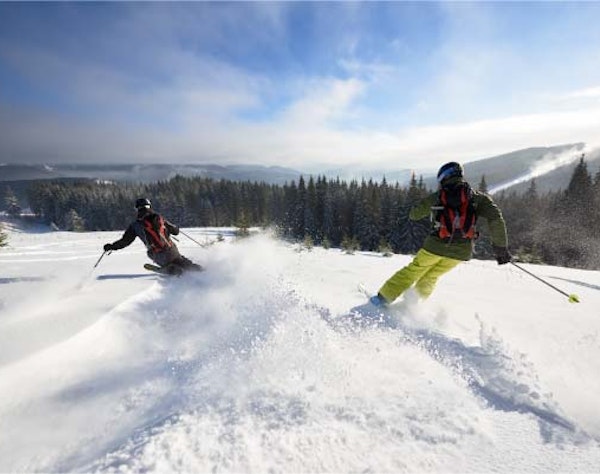
It refers to skiing outside the marked, groomed, and secured runs of a ski resort. Backcountry skiing owes much of its popularity to the sense of freedom it offers. It is synonymous with gliding through a wilder setting to enjoy fresh powder snow when weather conditions allow.
Backcountry skiing is well known for accidents at the edges of resorts or in isolated valleys. To enjoy it safely, follow these rules. Here are some tips to stay safe while backcountry skiing.
What does backcountry skiing mean?
Backcountry skiing can take many forms, and the range of practices is wide.
For example, skiing at the edge of the piste or in off-piste areas adjacent to groomed runs. This is a good way to experience skiing on ungroomed snow without taking too much risk. To do this, stay within the areas secured by ski patrol for avalanches, and on routes you have been able to observe from a chairlift or from a piste.
For more experienced skiers, it is possible to use ski lifts to access completely untouched valleys. But this should not turn into improvised freeride. Heading into a pristine valley on a whim, without equipment and without knowledge of the terrain, is the cause of many accidents. It is the most dangerous situation, as you risk triggering an avalanche or coming face to face with a rocky cliff. You should never assume that "accessible by chairlift" means "safe".



What are the risks of backcountry skiing?
To stay safe while backcountry skiing, you need to understand the 3 main risks inherent to this sport:
avalanche, which can bury a person under several metres of snow;
terrain, such as rocky cliffs, glacier crevasses, or falling seracs and cornices...;
injuries in an environment that is difficult for rescue teams to access: a head injury at a ski resort will, for example, be treated by ski patrollers much more quickly than one in a remote valley.
What behaviour should you adopt to stay safe while backcountry skiing?
Get trained to understand avalanche risks
An avalanche is not triggered by chance, but by the combination of several factors. While avalanche risk cannot be predicted with certainty, understanding the contributing factors can help minimise the danger of being buried under snow.
To assess the state of the snowpack, check the BERA (Avalanche Risk Assessment Bulletin), published every day throughout winter by Météo-France. Reading the BERA should never be limited to its numerical score (from 1 to 5), but should also include a detailed reading to understand the risk areas (which aspects, which altitudes, etc.).
To learn how to properly read a BERA and acquire the basics of avalanche risk awareness, you can attend training weekends organised by ANENA and mountain guide offices.
During these weekends, you will learn to avoid avalanches as well as how to use a DVA (avalanche victim detector), shovel, and probe to locate someone buried under an avalanche.
These courses will allow you to go freeride skiing, but also ski touring.
Preparing your freeride outing the day before
The day before a backcountry or freeride outing, a number of things need to be checked to ensure the day goes well. In particular:
check weather conditions, as a freeride outing in strong winds or fog can be dangerous. Make sure the weather is good enough to proceed;
choose a route suited to your ability, by checking that the slope gradient and elevation drop are not too challenging for you;
check snow conditions, as ungroomed snow does not necessarily mean powder. Freshly fallen snow transforms under the effects of wind, temperature, and skier traffic... The quality of the snow dramatically changes the difficulty of the descent. Light powder snow is easier to ski than heavy or crusted snow.


Never go alone and stay extra vigilant in areas without phone signal
Finally, on the day itself, to stay safe while backcountry skiing, make sure you don't go alone or without equipment (DVA, shovel, probe, and also a first aid kit). In case of a problem (avalanche or injury), being in a group makes a real difference.
Furthermore, there is no phone signal in some mountain areas. This means that if something goes wrong, it will take much longer to contact rescue services. This is a factor that should not be overlooked.
Getting started with freeride
To get started with backcountry skiing, it can be a good idea to be accompanied by a ski instructor or a high mountain guide to get started in the best possible conditions. This will give you a first safe introduction to the practice, and then allow you to get trained and become more independent.
Additionally, spring skiing is a great time to safely try backcountry skiing for the first time. At this time of year, avalanche risk is easier to manage and the snow is easier to ski... You won't have metres of powder snow, but these are conditions that lend themselves well to a first backcountry skiing experience.